
Seashore
I discovered recently that Freenet still exists. The less said about Freenet the better. It’s a perfect example of the phenomenon described in the above tweet: if you build something truly private, anonymous, deniable, and secure, it will attract people who need those things. Those users are, to put it mildly, unwelcoming. They are obnoxious enough to drive out any other users who don’t need strong guarantees on those things as much as they need a pleasant environment in which to talk.
Generalising, suppose we have a number of communication networks that are more-or-less decentralised. You would expect these to evolve a kind of stratification. Users willing to sacrifice comfort for “freedom” (defined in their terms, not mine) migrate lower. But since those users tend to be obnoxious, they drive users less obsessed with that kind of freedom higher up, into less decentralised and more comfortable networks. So the users of these networks organise themselves into a series of bands, like the organisms colonising the rocks on the sea shore.
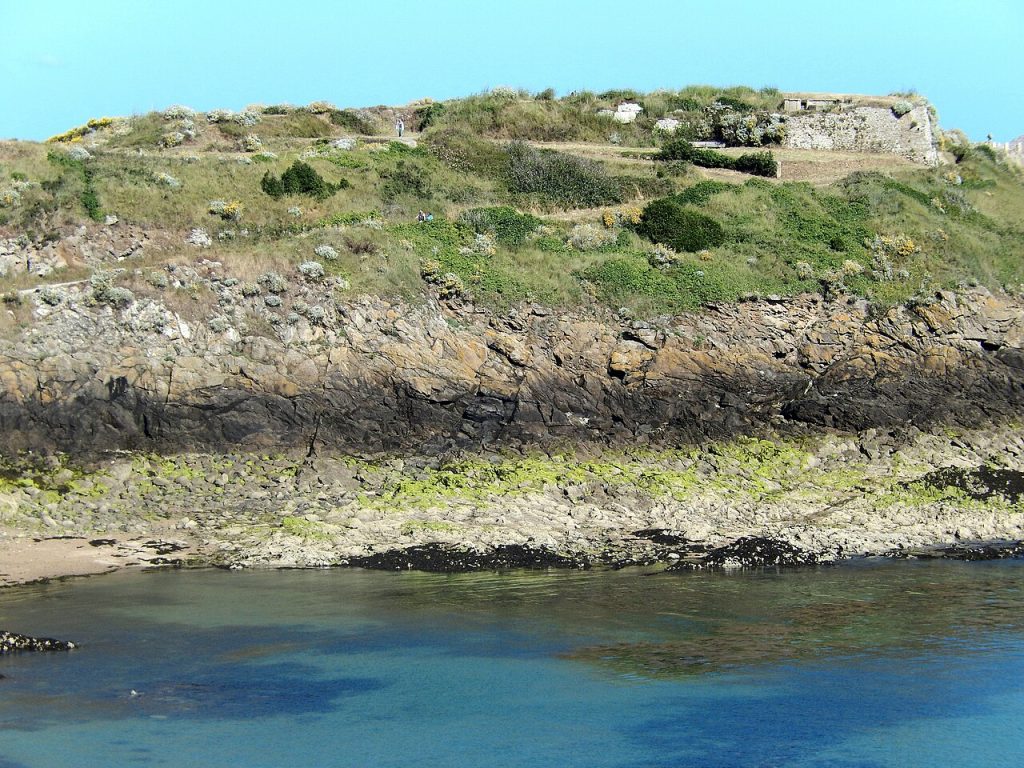

According to this model, the outlook for the Fediverse is bleak. It’s a network suitable for just one band of users, squeezed between Bluesky and Threads from above, Nostr from below. The potential userbase of the Fediverse is not the set of people who would benefit from decentralised communication. Rather it’s the set of people who feel that there is too little decentralisation on Bluesky, but too little moderation on Nostr. Given that hardly any normal people think about these issues in the first place, that’s not a lot of potential users.
Fedidrama
But there’s a less naturalistic way of thinking about this. The Fediverse includes many extremely obnoxious bad actors. But the main body of the Fediverse seals itself against those people with moderation, principally defederation. These tools are still crude. There is the Fediblock hashtag, but that requires manual intervention, and the criteria are unclear. There is IFTAS, but it is quite heavyweight and centralised, suitable only for blocking the worst elements. These are prototypes.
Bluesky has its composable moderation system, which is far more promising as a technical solution. But it doesn’t really have that much to do. The worst actors are necessarily blocked at the relay level rather than by labellers. So for all its technical sophistication, it remains undeveloped and untested.
Instead I think the most interesting phenomenon to explore is what gets hashtagged as “Fedidrama”. Specifically, the arguments that break out between admins of individual instances, usually caused by or resulting in sites defederating from each other. You can see this as a quest by individual actors to carve out a safe space within the Fediverse. The drama exists because there are no good automated mechanisms, neither are there well-established norms and institutions, but it is imperative to take ad-hoc action.
It’s ugly. But in a sense this is the development of a critical piece of technology. How exactly do you create a safe and welcoming community out of a fundamentally hostile landscape? Is that even possible? Many would say not, arguing that a worthwhile community needs to be built on the right foundations from the start. A Plato’s Republic kind of thinking. It’s also unclear if such welcoming communities need specific defined boundaries, including from each other, or if different communities can flow into each other at the edges while still protecting members at the centre.
These questions have been asked in the Fediverse for many years already, and they are still very much open. Nevertheless, progress is being made. Not in terms of specific rules or techniques, although those do form a part of what’s developing. It’s more a question of developing the right culture, such that people notice and avoid behaviour that leads to conflict, and fires die out quickly. And although outbreaks of Fedidrama are still common, I do feel that the heat has reduced over the last couple of years. That is not proof that workable solutions are being found, but it’s promising.
Transfer
If we can develop the social technology to establish a safe online community within a dangerous one, I’m betting that this can be transplanted to other networks. Likely the same ideas will work in Nostr and Bluesky. Perhaps, no matter how poisonous the bulk of Nostr is, there are still ways to mark out a civilised space within it.
This makes the Fediverse an important laboratory for the building of online communities. The Fediverse has fundamental flaws, including problems scaling up, security and safety in the protocol layer, standardisation and governance, and many other areas. Perhaps ActivityPub is not the right solution for most people after all. But it’s the only network taking seriously the idea of separating a network into different regimes.
It seems to me that networks like Bluesky are leaving an entire critical area un-explored, that is necessary for building a successful set of decentralised communitites. The Fediverse is filling that gap.